
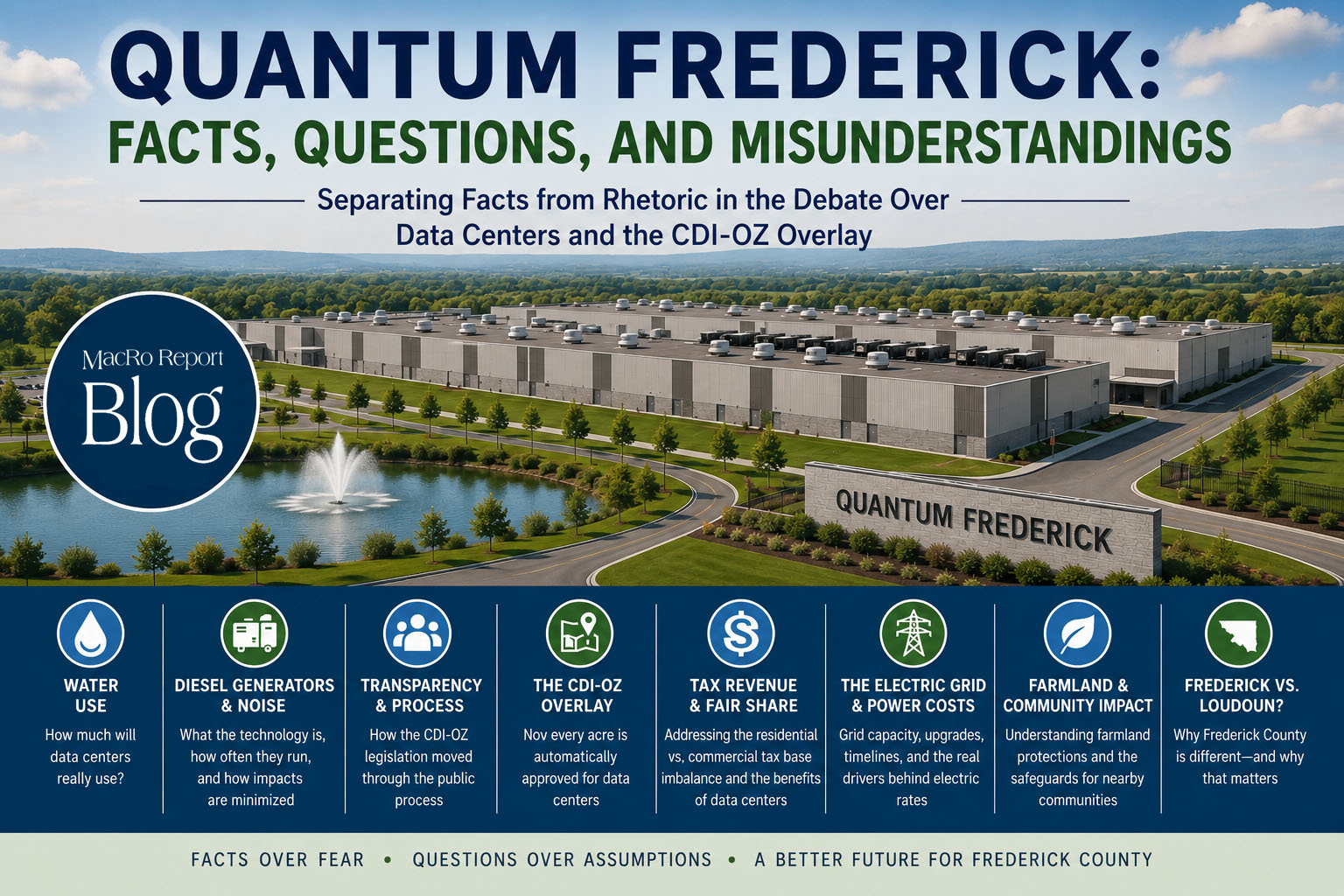
With the June primary election underway, Quantum Frederick and the CDI-OZ Overlay have become central topics in county politics. Candidates, activists, and residents have raised concerns about water consumption, electric demand, diesel generators, transparency, farmland preservation, and the long-term impact of data centers on Frederick County.
Public debate is healthy and necessary. Large-scale projects deserve careful scrutiny. However, some of the statements being repeated on the campaign trail and across social media deserve additional context.
This article is not intended to convince anyone to support or oppose data centers. Rather, its purpose is to separate established facts from assumptions, speculation, and political rhetoric.
Claim #1: Data Centers Will Exhaust Frederick County’s Water Supply
Water usage is perhaps the most frequently cited concern.
The reality is that data center water consumption varies dramatically depending on the cooling technology employed by individual operators. Thus far all the data centers within the Quantum Frederick project use what is known as Closed-Loop, Air-Dominant and Near-Zero-Water Cooling systems that actually use a minimal amount of water as compared to earlier data center projects in other parts of the country. These newer technologies significantly reduce consumption.
Therefore, claims that Quantum Frederick will “drain Frederick County dry” are not supported by the information currently available.
For readers interested in a deeper analysis, I encourage you to review my previous article examining projected water usage at Quantum Frederick, including comparisons with other commercial and industrial users and a discussion of modern cooling technologies.
Claim #2: Thousands of Diesel Generators Will Pollute the Air and Create Constant Noise
This concern deserves serious discussion because backup generators are an essential component of modern data centers.
The key distinction is that these generators are designed primarily for emergencies and periodic testing—not for continuous operation.
Modern Tier 4-compliant generator systems represent the highest emissions standards currently available. In addition, data center operators increasingly employ sound attenuation walls, enclosed courtyards, advanced muffler systems, and coordinated testing schedules.
In fact, under normal operating conditions, backup generators may only operate for limited testing and maintenance purposes – often as little as 15 minutes per unit per month during business hours.
Will generators create some noise and emissions? Certainly, but again with Tier 4 technology and the significant amount of heavily walled screening, the impact can be negligible.
I will cover this topic in a future article discussing Tier 4 backup generators in greater detail, including testing schedules, emissions standards, noise mitigation practices, and the safeguards being incorporated into the Quantum Frederick campus.
Claim #3: The Public Was Never Told About This Project
Some critics argue that the public was blindsided by Quantum Frederick.
Others point out that the planning process has been underway for years.
Between the site planning for the Quantum project and the CDI-OZ legislation, the entire process took years and moved through Frederick County’s normal legislative process, including public hearings, Planning Commission review, County Council deliberations, staff reports, and multiple public meetings.
Reasonable people may disagree about whether sufficient public outreach occurred.
However, it is difficult to argue that the project was hidden. The legislative process occurred in public view and followed the county’s established procedures.
Readers seeking more detail may wish to review my previous article explaining the Frederick County zoning and legislative process that led to the adoption of the CDI-OZ Overlay.
Claim #4: Every Acre Within the CDI-OZ Overlay Is Already Approved for Data Centers
This is one of the most misunderstood aspects of the entire debate.
The CDI-OZ Overlay encompasses approximately 2,615 acres. However, not all of that acreage is industrially zoned.
A substantial amount of the acreage remain agriculturally zoned and would be require to undergo lengthy additional approvals before data centers could be constructed there. Future projects would also remain subject to development review processes and regulatory requirements.
In short, the CDI-OZ Overlay created a framework—not blanket approval for every acre.
This distinction is important because many public discussions incorrectly assume that every parcel within the overlay has already been approved for development. That is simply not the case.
Claim #5: Data Centers Do Not Pay Their Fair Share
Opponents often argue that data centers receive benefits while taxpayers absorb the costs.
Supporters point to a different set of facts.
The land transactions associated with Quantum Frederick have already generated substantial recordation tax revenue. Future development will generate significant real property tax revenue, personal property tax revenue, construction-related economic activity, and utility infrastructure investment.
Some estimates suggest that, upon full buildout, the CDI-OZ district could contribute a significant percentage of Frederick County’s annual tax revenues while occupying only a small fraction of the county’s total land area.
More importantly, this discussion highlights a broader issue that has become a recurring theme throughout this year’s County Council campaigns: the imbalance between Frederick County’s residential tax base and its commercial and industrial tax base.
For decades, Frederick County has experienced substantial residential growth. While residential development generates tax revenue, it also creates significant demand for schools, roads, public safety services, parks, libraries, and other county-funded services.
Commercial and industrial properties generally require far fewer public services relative to the tax revenue they generate.
Many candidates have acknowledged that one of Frederick County’s greatest long-term challenges is expanding its commercial and industrial tax base so that homeowners are not forced to shoulder an ever-increasing share of the county’s financial obligations.
Data centers represent a significant potential solution to that challenge. Unlike residential development, they generate substantial tax revenues while creating relatively little demand for schools, parks, and many other county services.
The economic benefits are relatively easy to quantify.
Claim #6: The Electric Grid Cannot Support Data Centers
Many residents worry that Frederick County’s electric system cannot support the anticipated growth.
The reality is that electric infrastructure planning occurs through a lengthy process involving utilities, transmission providers, state regulators, and the PJM regional transmission organization.
One often-overlooked fact is that the former Eastalco site already possesses significant electrical transmission infrastructure that was originally built to serve one of the largest industrial facilities in Maryland. That existing infrastructure is one reason why the site became attractive for data center development in the first place and will supply a very large percentage of the power needed to meet the demands of the project.
Going forward, additional transmission upgrades may be required. Such upgrades typically take years to plan, approve, and construct.
Importantly, Quantum Frederick itself is expected to build out over many years—possibly well over a decade—rather than appearing all at once.
The question is not whether upgrades will be required. The question is how those upgrades will be planned, funded, and phased over time.
Claim #7: Residential Electric Bills Will Skyrocket
This concern is understandable given recent increases in electric costs throughout Maryland.
However, many factors contribute to electricity prices, including generation shortages, transmission investments, state energy policies, environmental mandates, and regional market conditions.
Data centers unquestionably increase demand, but that does not necessarily translate into higher consumer prices.
In fact, many of the recent increases experienced by Maryland ratepayers stem from regional generation shortages, transmission costs, and statewide energy policy decisions that affect all customers regardless of whether a data center is located nearby.
At the same time, it would be inaccurate to suggest that data centers are solely responsible for rising electric costs or that every future increase can be attributed to Quantum Frederick.
Claim #8: Frederick County Is Becoming Loudoun County
This comparison appears frequently in public discussions.
The comparison has some value because Loudoun County demonstrates both the opportunities and challenges associated with large-scale data center development.
However, Frederick County is not Loudoun County.
Loudoun County’s data center industry developed over several decades and now includes hundreds of facilities spread across a much larger geographic area. Quantum Frederick represents a far smaller and more concentrated development strategy.
In addition, Frederick County incorporated planning requirements relating to buffering, setbacks, landscaping, water management, traffic circulation, noise mitigation, and environmental protections that reflect lessons learned from earlier data center development elsewhere.
A defining feature of the carefully planned CDI-OZ is its scale. By law, the overlay may cover no more than 1% of Frederick County’s total land area.
The question facing Frederick County is not whether it will become Loudoun County.
The question is whether it can successfully manage a limited amount of data center development in a manner that strengthens the county’s tax base while preserving the quality of life that residents value.
Claim #9: The CDI-OZ Eliminated Farmland Preservation
Another common claim is that the CDI-OZ Overlay eliminated permanently protected farmland.
The reality is more complicated.
At the time, the CDI-OZ overlay was approved, some of the acreage included within the overlay was located within Priority Preservation planning area. However, those designations are not the same as permanently preserved farmland protected by state and local agricultural preservation easements.
Properties that have been permanently preserved through agricultural easement programs remain protected.
The distinction is important because many public discussions have treated all agricultural land within the overlay as if it were permanently preserved farmland. In reality, different categories of land-use planning and preservation carry different legal protections and development restrictions.
As with many aspects of the CDI-OZ debate, understanding the details matters.
Final Thoughts
Quantum Frederick may ultimately become one of the most consequential economic development projects in Frederick County’s history.
Whether one supports or opposes the project, public policy should be based on facts rather than fear, and on evidence rather than assumptions.
There are legitimate questions about water usage, electrical infrastructure, backup generators, future approvals, and long-term impacts on surrounding communities. Those questions deserve thoughtful answers.
At the same time, residents should be cautious about accepting campaign rhetoric or social media claims without examining the underlying facts.
The conversation should continue.
But it should be grounded in what we know, what we do not know, and what questions still need to be answered.
Become a MacRo InsiderRocky Mackintosh, Broker of MacRo, LTD has been advising regional landowners, investors, and institutions for over 50 years. He has been an active member of the Frederick community for over five decades. He has served on a number of community organization boards including as a member of the Frederick County Charter Board from 2010 to 2012.
No quarrel with any of your answers to critics’ claims. But one objection to data centers (DCs) you haven’t tackled is their “incompatibility” with the charming landscape of Frederick County. Their charmlessness. Most DCs are dull flat boxes, and hugely out of scale and style with what we think of as special to the area. Except that they’re not much different in that regard from a lot of ‘light industrial’ buildings or for that matter modern agricultural buildings. Of course new DCs are much bigger than the similarly styled metal buildings going up on farms. But they’re similar in vast size to the ‘fulfillment centers’ with scores of tractor-trailer gates. The strongest argument for DCs is that our adoption of the internet is so central to our contemporary way of life and economy we are inevitably going to get hyperscale data processing one way or another. If we banish it from Frederick County, we’ll just be more dependent on DCs elsewhere.