
Over the past several months, Rocky Mackintosh has written a series of articles designed to help residents better understand what is actually happening within Frederick County’s CDI-OZ Data Center District. This twentieth installment focuses on one of the most frequently discussed—and often misunderstood—components of modern data centers: backup power generators.
Why Backup Generators Exist
Among the many issues being discussed regarding the Quantum Maryland campus in Frederick County, few have generated more debate than backup diesel generators. Social media posts, political campaign rhetoric, and community discussions frequently raise concerns about noise, air pollution, and the potential cumulative impact of hundreds of generators operating throughout the CDI-OZ district.
These concerns deserve thoughtful consideration. However, as with many aspects of the data center debate, it is important to distinguish between assumptions and facts.
When most people think of a data center, they picture rows of servers, blinking lights, and powerful computers processing enormous amounts of information. What many do not realize is that behind every major data center sits another critical piece of infrastructure: a fleet of backup generators designed to provide emergency power if the electrical grid experiences an interruption.
These generators are not unique to data centers. Hospitals, airports, emergency communications centers, military installations, water treatment facilities, and countless other critical facilities rely on backup generators to ensure uninterrupted operations. Data centers are no different.
The Importance of Reliability
Modern society depends upon digital infrastructure. Financial institutions, cloud computing platforms, government agencies, first responders, healthcare providers, and thousands of businesses rely on data centers operating continuously. Even brief interruptions can have significant consequences. For this reason, modern hyperscale data centers are designed to achieve what the industry calls “five nines” reliability—99.999% uptime.
When utility power is lost, data centers do not immediately switch to diesel generators. Instead, sophisticated battery systems known as Uninterruptible Power Supplies (UPS) instantly carry the electrical load. These batteries provide power for several minutes while backup generators automatically start and synchronize with the facility’s electrical system. Within seconds, the generators assume the load and can continue operating for as long as necessary.
Why Diesel Remains the Industry Standard
One of the most common questions is why diesel generators continue to be used instead of batteries, solar power, or natural gas.
The answer is reliability.
Diesel engines can sit idle for months and still start within seconds when needed. They provide predictable power output and have decades of proven performance in critical applications. While battery technology continues to improve, it remains impractical and prohibitively expensive to provide multi-day backup power for facilities that may require hundreds of megawatts of electricity.
For now, diesel remains the preferred emergency power source for hospitals, airports, emergency operations centers, military facilities, and data centers.
What Is a Tier 4 Generator?
Equally important is the fact that today’s generators bear little resemblance to older diesel engines that many people remember from decades past.
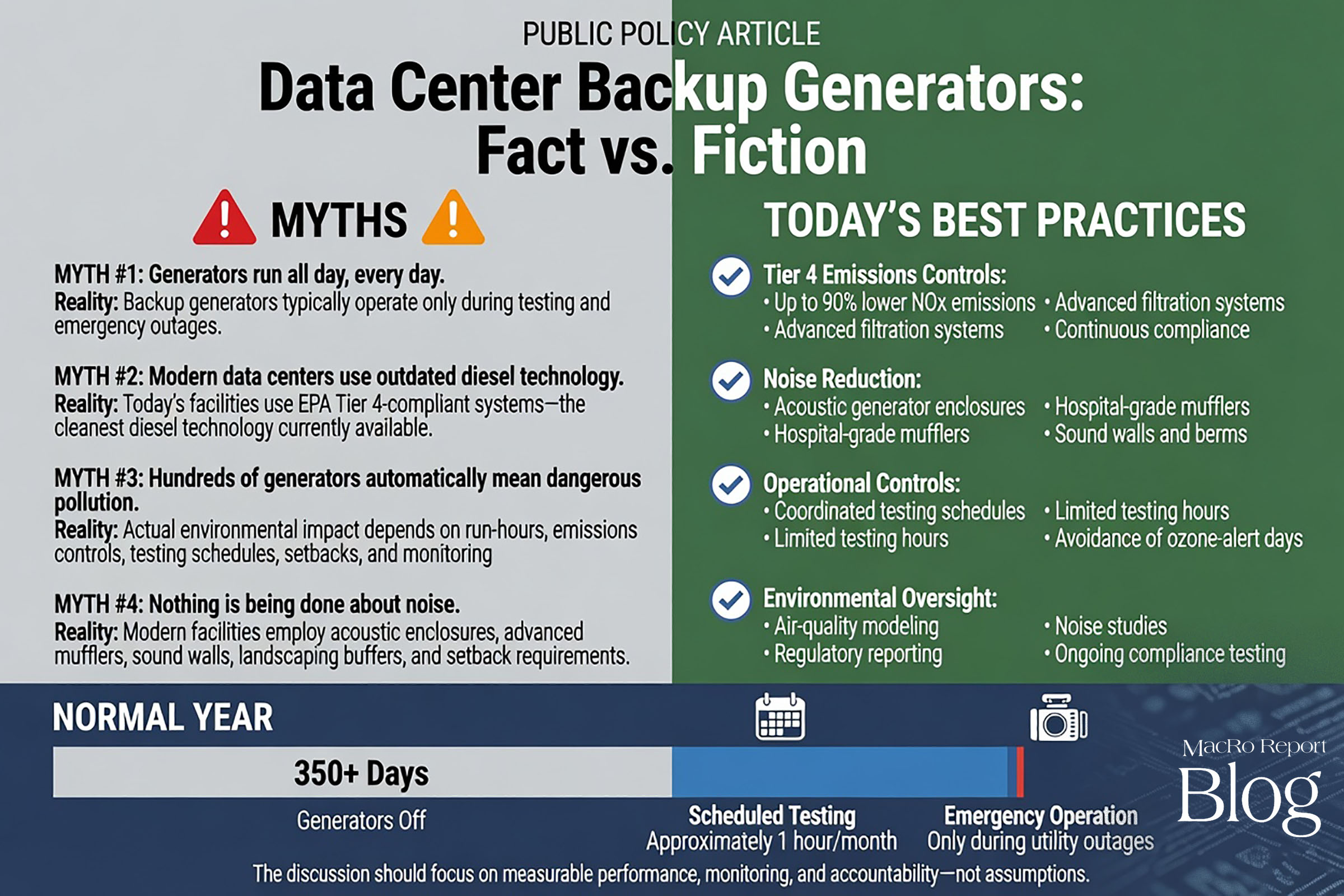
Modern facilities utilize EPA Tier 4-compliant generator systems, which represent the cleanest diesel technology currently available.
Compared to previous generations of diesel engines, Tier 4 systems can dramatically reduce emissions of nitrogen oxides (NOx) by 90%, carbon monoxide by 80%, particulate matter by 70% among other compounds. Advanced emissions-control technologies, including diesel particulate filters, oxidation catalysts, and selective catalytic reduction systems, have transformed diesel emissions performance.
These are the same types of technologies now commonly found on modern heavy-duty trucks and construction equipment.
How Often Do Generators Actually Run?
Perhaps the most misunderstood aspect of data center generators is how infrequently they operate.
Some social media discussions create the impression that hundreds of diesel engines will be running continuously. In reality, backup generators spend the overwhelming majority of their lives turned off. Their primary purpose is emergency power.
Outside of emergencies, they are periodically tested to ensure they will function when needed. Industry data indicates that many generators operate less than 15 hours annually outside of actual power outages – and in some cases less than 15 minutes per unit per month.
More than likely, most of the generators within the Quantum Maryland campus will be tested during normal business hours under carefully regulated conditions.
Addressing Noise Concerns
Noise is another concern frequently raised by nearby residents.
Here again, technology has advanced considerably. Modern generators are typically housed within sound-attenuated enclosures and equipped with advanced muffler systems. Developers increasingly employ berms, sound walls, landscaping buffers, and strategic setbacks to minimize impacts on surrounding properties.
In addition, coordinated testing schedules and ongoing sound monitoring are becoming recognized best practices throughout the industry.
Looking Toward the Future
As the CDI-OZ district continues to develop over the coming decades, backup power technology will continue to evolve as well. The Tier 4-compliant systems being installed today represent the most advanced and environmentally responsible diesel-generator technology currently available. However, like many forms of technology, future generations of backup power systems will likely become even cleaner, quieter, and more efficient.
The conversation should therefore focus not only on today’s equipment, but also on the processes that will guide future development. Working together, data center operators, property owners, regulatory agencies, and Frederick County government can ensure that best practices continue to evolve alongside the industry.
These best practices include cumulative air-quality studies, noise studies, coordinated generator testing schedules, transparent public reporting, and ongoing regulatory oversight. Such measures help ensure that potential impacts are identified, monitored, and addressed as development occurs.
Fortunately, these tools already exist within today’s permitting and regulatory framework. Modern modeling technology allows engineers to evaluate air-quality and noise impacts before facilities are built, while ongoing monitoring helps verify that operational standards continue to be met over time.
As with many aspects of the data center discussion, the goal should not be to ignore concerns, nor to assume the worst. Rather, it should be to rely on facts, science, and continuous improvement to ensure that critical infrastructure and quality of life can coexist successfully.
The Facts Matter
The bottom line is that concerns about generator operations should neither be dismissed nor exaggerated.
Backup generators are an essential component of the infrastructure that supports our increasingly digital world. At the same time, modern Tier 4-compliant systems, combined with rigorous permitting requirements, advanced monitoring, and responsible operating practices, can substantially mitigate many of the concerns that are often raised.
As Frederick County continues its discussion about data centers and the future of the CDI-OZ district, it is important that residents, elected officials, developers, and community advocates remain focused on facts.
The most productive conversations are not driven by fear, speculation, or campaign slogans. They are grounded in engineering, measurable performance standards, regulatory oversight, and a clear understanding of how today’s technology actually works.
In the end, good public policy is built on facts, and the facts matter.
Become a MacRo InsiderRocky Mackintosh, Broker of MacRo, LTD has been advising regional landowners, investors, and institutions for over 50 years. He has been an active member of the Frederick community for over five decades and has served on a number of community organization boards, including as a member of the Frederick County Charter Board from 2010 to 2012. He has firsthand experience supporting nationally recognized hyperscalers with site search and selection services throughout the Mid-Atlantic.
For a few years the generator folks have known that as much as 70-90% Hydrogen can be used as fuel in diesel generators with minimal modification. This allows for smooth transition over time to the newer options that are tentatively planned.
You’re correct that hydrogen-assisted diesel technology has been under development for several years, and some dual-fuel systems have demonstrated high hydrogen substitution under certain conditions. However, those systems are not yet the industry standard for large hyperscale data center backup generators. The larger trend appears to be toward dedicated hydrogen fuel-cell systems or hydrogen-powered engines as the technology, fuel infrastructure, and economics mature. It will be interesting to see how quickly those technologies become commercially viable for facilities like Quantum Maryland.