
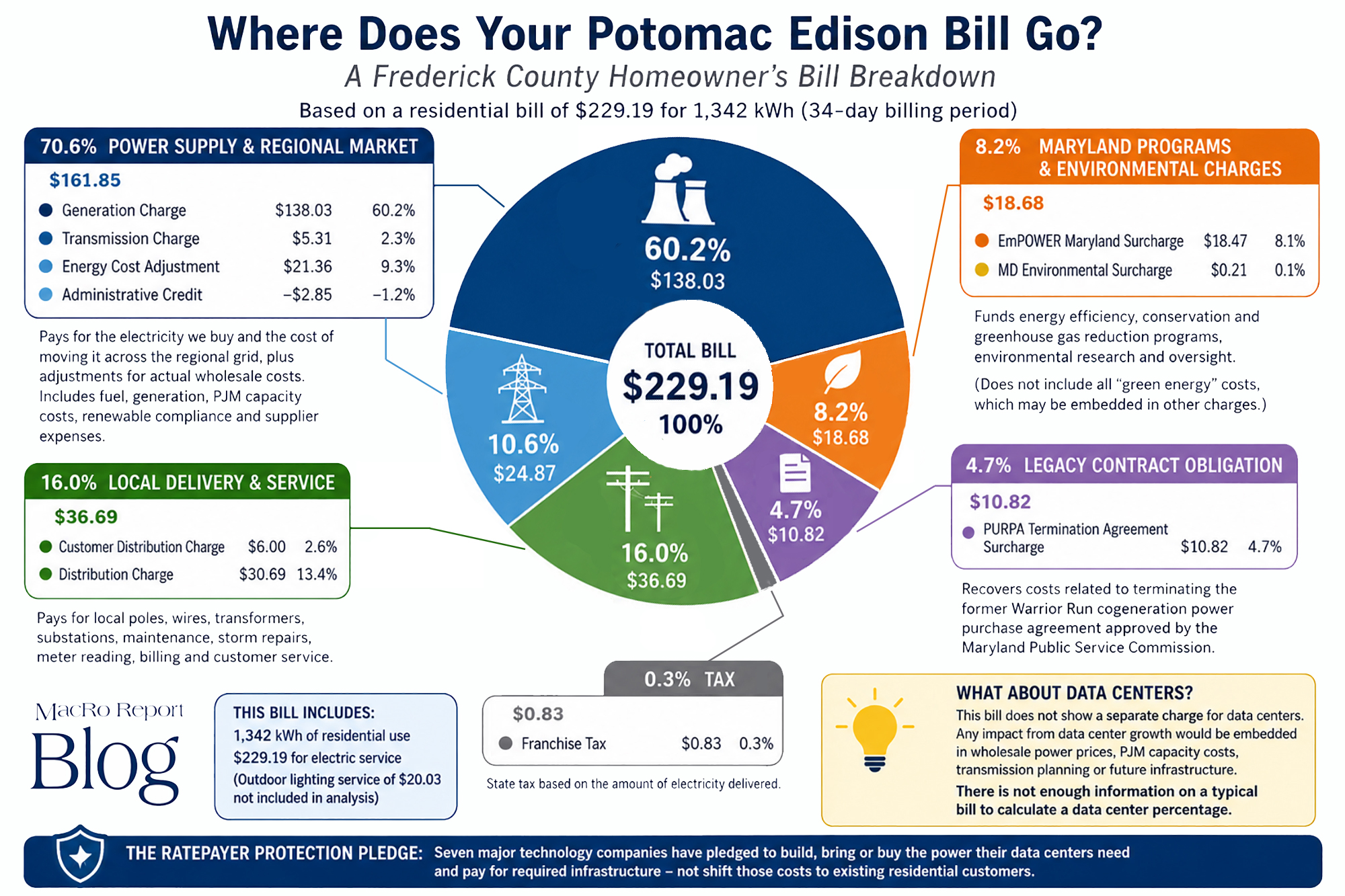
When you open your electric power bill to review last month’s charges and study it, do you really know what you are paying for? It may surprise you! Here’s a quick summary in our 29th article of the MacRo Report Blog’s AI Corner.
Last week, I examined the many factors contributing to Maryland’s rising electricity costs. Government energy policies, power-plant retirements, PJM capacity prices, transmission investment, inflation and growing electricity demand all play a role.
But that discussion raised a more basic question:
What are Frederick County homeowners actually paying for when their electric bill arrives?
To find out, I analyzed the most recent Potomac Edison bill for my old energy inefficient 1853 farmhouse in Adamstown. The residential portion totaled $229.19 for 1,342 kilowatt-hours of electricity used during a 34-day billing period. A separate $20.03 outdoor-lighting account was excluded from this analysis because it includes fixture and lighting-service charges that are not part of ordinary household electric service.
How much paid for the actual electricity?
The largest line item was the Generation Charge: $138.03, or 60.2% of the residential bill.
This is the closest visible measure of what paid for the electricity supplied to the house. However, even this category is not simply the cost of fuel or electrons produced at a power plant. It can include wholesale power contracts, PJM capacity obligations, supplier expenses and costs associated with complying with Maryland’s renewable-energy requirements.
When the Generation Charge is combined with the Transmission Charge, Energy Cost Adjustment and offsetting Administrative Credit, broader power-supply and regional-market costs totaled approximately $161.85, or 70.6% of the bill.
The remaining 29.4% paid for local distribution, account service, Maryland programs, taxes and a surcharge associated with terminating an older power-purchase agreement.
How much supported environmental and efficiency programs?
Two separately identified charges were most clearly related to Maryland energy and environmental programs:
- EmPOWER Maryland surcharge: $18.47
- Maryland environmental surcharge: $0.21
Together, they represented $18.68, or approximately 8.15% of the residential bill.
That does not necessarily represent the complete cost of Maryland’s “green energy” policies. Renewable-energy credits, carbon-allowance costs under the Regional Greenhouse Gas Initiative and other compliance expenses are not separately itemized. Some may be embedded within the Generation Charge or other broader categories.
In other words, 8.15% is the amount that can be clearly identified—not necessarily the total environmental-policy cost.
How much was caused by data centers?
The honest answer is:
This bill does not tell us.
There is no charge labeled “data centers.” Any effect from data-center growth would most likely be embedded in PJM capacity costs, wholesale supply prices, transmission planning or future utility investments.
Data centers are clearly increasing projected electricity demand, but it would be misleading to assign a specific portion of this bill to them without more detailed information from PJM, Potomac Edison and Maryland regulators.
The most legitimate public concern is not simply how much electricity data centers use. It is whether homeowners will be required to finance the new power plants, transmission lines and substations built primarily to serve them.
The Trump administration’s Ratepayer Protection Pledge directly addresses that issue. Seven major technology companies agreed to build, bring or buy the additional generation needed for their data centers, pay for required delivery-infrastructure upgrades and continue paying for reserved power and infrastructure even if they do not use all of it. The stated goal is to prevent these incremental costs from being shifted to ordinary households. (The White House)
Whether those protections are fully incorporated into future Maryland utility tariffs remains to be seen. But the principle is straightforward:
Data-center growth should pay for the infrastructure it creates.
The deeper lesson from this bill is that electricity charges are far more complicated than most consumers realize. Only about 60% was visibly labeled as generation, while the remainder paid for delivery, market adjustments, public programs, taxes and historical obligations.
As part of this study, I have drafted a detailed companion white paper entitled Understanding Your Electric Bill – A Frederick County Homeowner’s Guide. This explains every line item and identifies which costs arise from electricity supply, utility infrastructure, government policy and legacy regulatory decisions.
Become a MacRo InsiderRocky Mackintosh, Broker of MacRo, LTD has been advising regional landowners, investors, and institutions for over 50 years. He has been an active member of the Frederick community for over five decades and has served on a number of community organization boards, including as a member of the Frederick County Charter Board from 2010 to 2012. Learn about his recent affiliation with Mackintosh, Inc., Commercial Real Estate.
I appreciate all of your articles on this and other subjects. The reality is that electric charges have risen dramatically everywhere data centers have cropped up and Frederick County will be no different. It would be nice if someone could do an analysis of Loudon County rates over say the last five years. I think we will see close to the same increases. I don’t have much faith that the MD Public service commission will do much but rubber stamp their requests given their past history.
Robert, thank you for following the articles and for suggesting a five-year look at Loudoun County’s electricity rates. That would be a worthwhile comparison.
In my September 10 article, “What Is Really Driving Maryland’s Higher Electric Bills?” I noted that Maryland’s average residential electricity price in 2024 was approximately 24% higher than Virginia’s, despite Virginia’s enormous concentration of data centers, particularly in Loudoun County. To be precise, those were statewide averages, not a separate analysis of Loudoun’s rates.
That comparison does not mean Loudoun residents haven’t experienced increases, or that data centers have no effect. It does suggest that the relationship is more complicated than assuming more data centers automatically produce higher residential rates. A useful five-year analysis would compare charges for the same amount of electricity and examine what drove the increases.
As Article 29 explains, my own electric bill does not reveal how much, if any, of its charges can be attributed to data centers. Assigning responsibility requires more information than the bill provides.
Your concern about regulatory oversight is fair to raise. I believe the PSC should be judged by the enforceable protections it adopts and the costs it allows utilities to pass along to households. Data-center developers should pay the costs their growth creates. Residents deserve transparent accounting and measurable protections—not simply assurances.