

Data centers are part of the discussion—but government policy, constrained power supply and years of rising grid costs deserve far more attention. In this 28th post of the MacRo Report Blog’s AI Corner, Rocky Mackintosh takes a deeper look into what we are actually paying for.
Maryland residents do not need an economist to tell them that electricity has become more expensive. They see it every month when the bill arrives.
The explanation heard most frequently today is that data centers are consuming enormous amounts of power and forcing residential customers to pay more. With major data center development underway in Frederick County and throughout the PJM region, that concern deserves to be taken seriously.
But it also deserves to be examined carefully.
The available evidence indicates that data centers may contribute to future generation, capacity and transmission costs—particularly when demand grows faster than new power supplies can be developed. However, they do not explain the full rise in Maryland’s electric rates. Many of the costs now reaching consumers were created by federal and state policies, grid investments, inflation and power-supply decisions made long before the current AI boom.
Maryland’s rates compared with other states
According to the U.S. Energy Information Administration, Maryland’s average residential electricity price in 2024 was approximately 17.86 cents per kilowatt-hour, compared with a national average of 16.48 cents.
Several states with less prescriptive energy-policy systems were considerably lower:
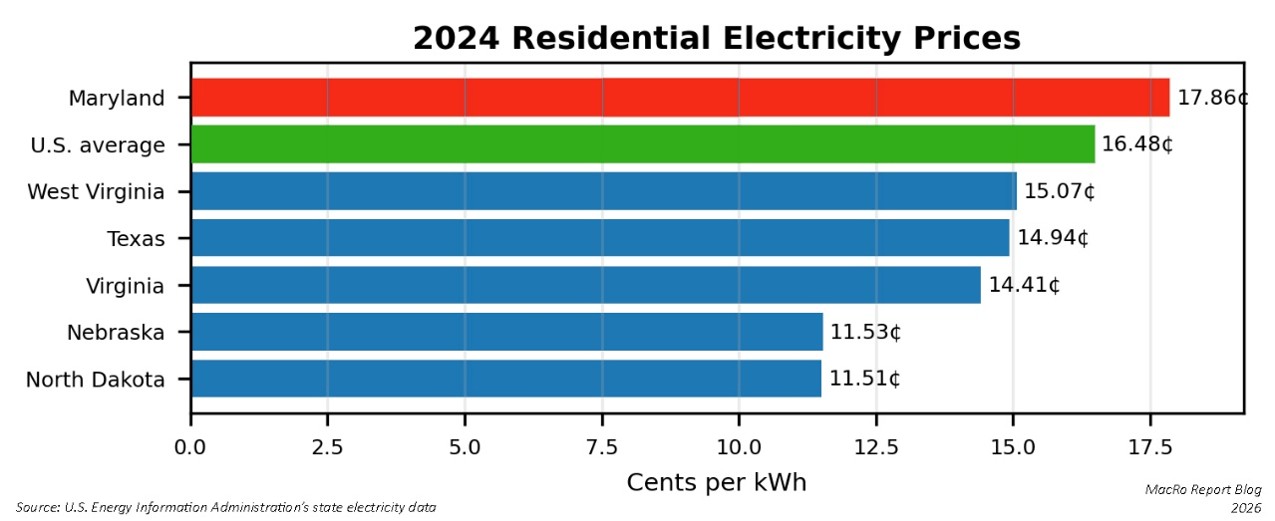
Maryland’s average price was approximately 24% higher than Virginia’s and about 55% higher than those of Nebraska and North Dakota. The underlying figures are available through the U.S. Energy Information Administration’s state electricity data.
This comparison does not prove that any single Maryland policy caused the difference. States have different climates, generation resources, utility structures and historical investments. But it demonstrates that high electricity prices cannot automatically be attributed to data-center growth.
Virginia is especially important. It shares the PJM regional market with Maryland and has by far the nation’s largest concentration of data centers. Nevertheless, its 2024 residential rate remained substantially below Maryland’s.
If data centers alone determined residential electricity prices, one would expect Virginia to be among the most expensive states in the country. It was not.
A broader national pattern
A recent article by Ken Girardin titled “Electric Shock”, published by City Journal, argues that many recent electric-price increases are the result of policy choices rather than simply greater demand.
Girardin reports that national residential electricity rates increased approximately 27% between 2019 and 2024, but that the increases were highly uneven. Maryland was among the states with the largest percentage increases which topped 36% since 2019, while inflation during that period totaled 20%.
California, New York, Maine, Maryland and the District of Columbia experienced substantially greater increases than many states with fewer climate and renewable-energy mandates, pushing their 2024 rates to 31.97¢, 24.43¢, 24.29¢,17.86¢ and 17.17¢ respectively – all substantially above the national average of 16.48¢.
His central argument is that policymakers have gradually placed numerous public-policy expenses into electric rates, including:
- renewable-energy procurement mandates;
- carbon-allowance programs;
- offshore-wind commitments;
- transmission required to connect remote renewable projects;
- subsidies and incentives;
- grid modernization;
- electrification programs; and
- costs shifted among different categories of customers.
Girardin argues that utilities frequently become the collection mechanism for policies lawmakers want to pursue without funding them through ordinary taxation. Those charges are then incorporated into supply prices, delivery rates or less-visible bill adjustments.
Its conclusions raise a legitimate question:
How much of today’s electric bill reflects the actual production and delivery of power, and how much reflects government-directed programs layered onto the electrical system?
Maryland consumers are rarely given a clear answer.
Maryland’s policy commitments
Maryland has adopted one of the most ambitious climate-policy structures in the nation.
It includes:
Renewable-energy requirements
Electricity suppliers must obtain renewable-energy credits to satisfy Maryland’s Renewable Portfolio Standard. Those credits represent a cost of compliance, even when they do not appear as a clearly identified line on a customer’s bill.
Offshore-wind commitments
Maryland has pursued offshore wind through state-authorized renewable-energy-credit programs and procurement policies. Offshore wind can provide carbon-free electricity, but it comes at a cost to the consumer and requires specialized generation, transmission and long-term financial commitments.
RGGI carbon allowances
Maryland participates in the Regional Greenhouse Gas Initiative. Fossil-fueled generators that an uninterrupted power supply to hospitals, airports, emergency communications centers, military installations, water treatment facilities, data centers and countless other critical facilities must purchase carbon allowances for their emissions. Although the state uses auction proceeds for energy and environmental programs, generators incorporate compliance costs into their market offers.
Building electrification and efficiency programs
The Climate Solutions Now Act of 2022 requires the state to reduce greenhouse-gas emissions 60% below 2006 levels by 2031 and achieve net-zero emissions by 2045. It also expands energy-efficiency requirements, building-emissions programs, electrification initiatives and other statewide measures. The Maryland Department of the Environment describes these goals as among the most ambitious in the country.
The state argues that these policies will produce long-term economic, environmental and household-energy benefits. Maryland’s Climate Pollution Reduction Plan projects that electrification, heat pumps, electric vehicles and efficiency improvements could eventually reduce total household energy spending.
Assuming that there will be a benefit that will eventually reduce the costs to the consumer, it’s important to acknowledge the near- and intermediate-term cost of transforming the system.
Transmission and distribution investment
Moving electricity from new generation resources to customers requires new transmission lines, substations, interconnections and distribution upgrades. These costs are generally recovered through regulated rates.
The Maryland Public Service Commission is responsible for reviewing utility rates, allocating costs among customer classes and deciding which investments may be recovered from its customers. Its own description of the rate-setting process makes clear that rates reflect operating costs, utility investments, cost allocation and authorized returns—not merely the price of the electricity itself.
Where data centers legitimately enter the picture
None of this means data centers have no effect.
The PJM system is experiencing rapid load growth at the same time that older power plants are retiring and new generation projects face lengthy interconnection and permitting delays. Data centers represent a substantial portion of projected demand growth in parts of the region. The company and the utilities that operate within its system have struggled to expand and modernize the grid quickly enough to keep pace with changing electricity demand and the retirement of older generating plants.
When demand grows faster than supply, several things can happen:
- wholesale energy prices may rise during periods of tight supply;
- PJM capacity prices may increase;
- new transmission and substations may be required;
- utilities may need to reserve generation for very large customers; and
- consumers may face costs if those investments are improperly allocated.
A growing number of commentators argue the case against data centers. They point to sharply higher PJM capacity prices and argue that data-center demand is consuming the reserve margin previously available during extreme weather.
That concern cannot simply be dismissed. But they often blend several different concepts: real-time wholesale prices, capacity-auction costs, system reliability and the complete residential electric bill. Those are related, but they are not interchangeable.
A capacity-price increase can affect consumer bills without explaining every increase in generation, transmission, distribution and government-mandated charges.
What the research says
One of the more interesting articles I reviewed was written by Shawn Regan, a senior fellow at the Manhattan Institute, titled “Data Centers Aren’t Raising Your Power Bill. Bad Policies Are.”
Among other references, he cites recent research from the Electric Power Research Institute (EPRI), Columbia University and Lawrence Berkeley National Laboratory that, between 2015 and 2024, states experiencing greater data-center growth did not necessarily experience higher residential rates. In some cases, large, steady customers may have reduced average costs by spreading the grid’s fixed expenses over more electricity sales. The authors caution, however, that future supply constraints could reverse that result.
That qualification may be the most important part of the entire debate.
Data centers do not inherently raise residential rates. Their effect depends on:
- whether generation is allowed to expand;
- whether transmission can be permitted and built;
- whether large customers pay the costs of their own connections;
- whether utilities secure minimum-payment commitments;
- whether new infrastructure is used efficiently; and
- whether regulators protect existing ratepayers from stranded costs.
A large customer that pays its full cost and uses the system steadily may actually benefit other customers.
On the other hand, a large customer connected to a supply-constrained grid under a poorly designed tariff may increase their costs.
Both outcomes are possible.
The real issue is supply—and who pays
The Trump administration’s Ratepayer Protection Pledge addresses the second issue by requiring or encouraging AI companies and data-center developers to pay for generation and grid infrastructure (including transmission line and substation construction, etc.) created by their demand rather than shifting those costs to households. Major technology companies including Microsoft, Amazon, Google, Meta, Oracle, OpenAI and xAI—have agreed to support that principle.
Maryland should apply the same basic principle:
Growth should pay for the measurable costs of growth.
That means special large-load tariffs, firm financial commitments, minimum billing requirements and direct responsibility for dedicated substations, transmission and generation.
But protecting consumers also requires an honest accounting of the other costs already embedded in Maryland’s rates.
It is not credible to attribute every increase to data centers while ignoring renewable mandates, RGGI allowances, offshore-wind programs, transmission expansion, utility capital spending, inflation and the consequences of restricting conventional generation.
Nor would it be credible to claim that rapidly expanding data-center demand can never affect future prices.
A more honest conclusion
Maryland’s rising electric bills are not the product of one industry or one policy. They are the cumulative result of multiple decisions:
- the power resources Maryland has encouraged or discouraged;
- the environmental programs placed into utility rates;
- the pace at which reliable generation has been retired and replaced;
- growing transmission and distribution expenses;
- PJM’s changing supply-and-demand balance;
- inflation in labor, transformers, steel and other equipment; and
- rapidly increasing demand from data centers and electrification.
The public deserves more than a convenient scapegoat.
Following the commitments made under the previously noted Ratepayer Protection Pledge, data center developers should pay the infrastructure costs they create.
At the same time, Maryland policymakers should disclose how much residents are paying for government-directed energy programs and explain whether those programs are delivering the promised benefits.
Before blaming the newest customer on the grid for the entire bill, Maryland should provide consumers with a clear, itemized accounting of how that bill was created.
Next week
This article has focused on why the debate is more complicated than many people realize.
But it also raises another question.
What are Maryland consumers actually paying for every month?
In my next article, I’ll attempt to answer that question by breaking down a typical residential Potomac Edison bill into its major components using publicly available information from the Maryland Office of People’s Counsel, the Maryland Public Service Commission and other official sources.
Because before we can decide who’s responsible for higher electric bills…
…we first need to understand what we’re actually paying for.
Become a MacRo InsiderRocky Mackintosh, Broker of MacRo, LTD has been advising regional landowners, investors, and institutions for over 50 years. He has been an active member of the Frederick community for over five decades and has served on a number of community organization boards, including as a member of the Frederick County Charter Board from 2010 to 2012. Learn about his recent affiliation with Mackintosh, Inc., Commercial Real Estate.
Rocky & MacRo, I always enjoy your detailed research in the articles you publish. Most issues like this one is never a lone cause or reason. I enjoy your perspective. thank you for your insight.
Look forward to next installment. Since January 2024 my rate has increased 38% and 1/3 of my bill is for charging my EV, on a timer from 11p-6a where the rate is about $.08 versus higher standard residential rate. Without the lower overnight charge rate the increase would be significantly higher than 38% in just two years. Maryland is tough on your wallet. Electric bill surcharges as bad a $100 tax / add-on fees to rent a $200 car in Nashville.