
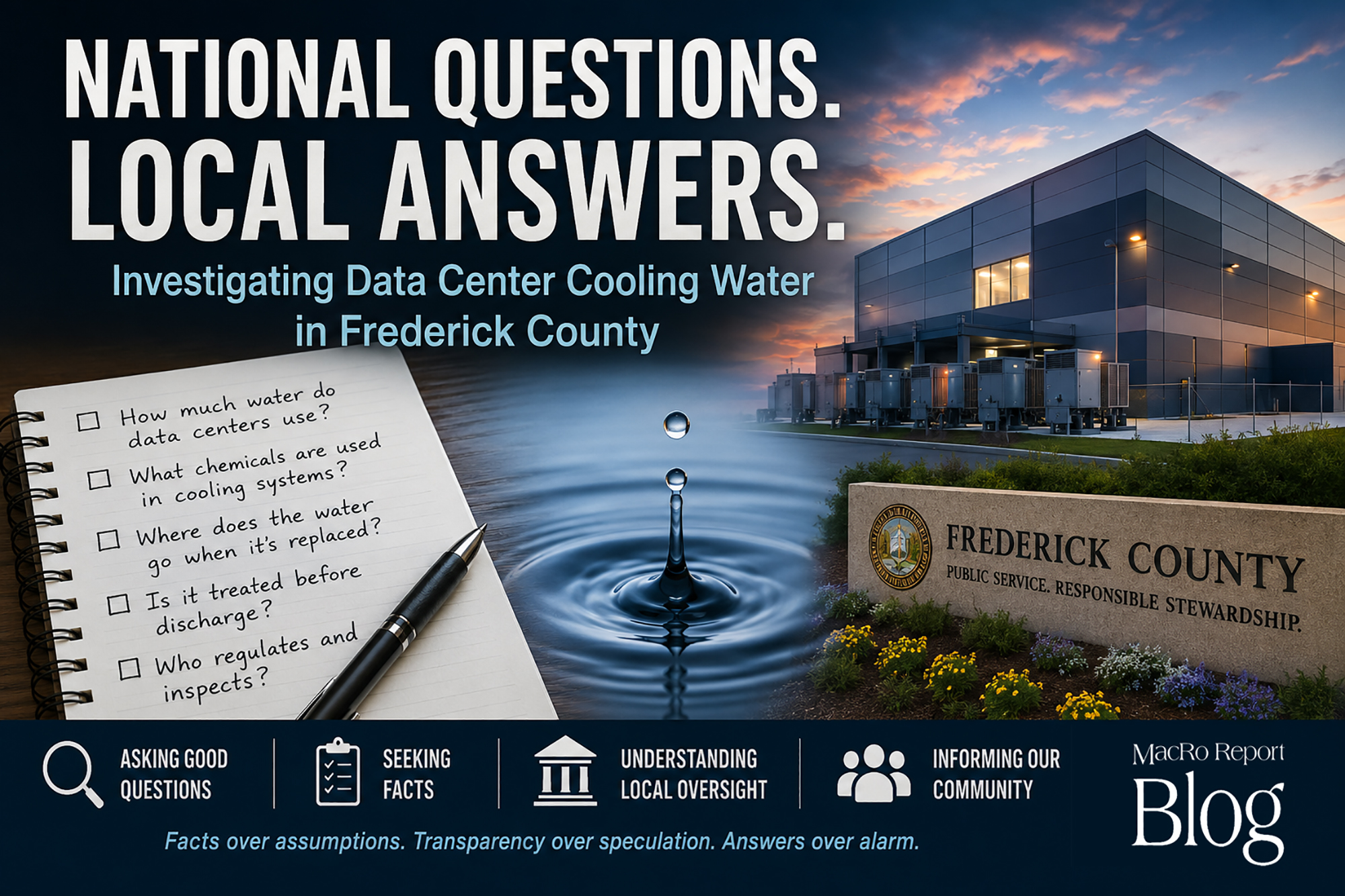
For the past eight months, I have been researching and writing about the growth of data centers in Frederick County. This article marks the 26th installment in the MacRo Report Blog’s AI Corner series examining one of the most significant economic and land use developments our community has faced in decades.
Throughout the series, I’ve explored topics ranging from tax revenue and electrical infrastructure to water consumption, backup generators, land use, environmental concerns, and community impacts. My objective has remained consistent from the very beginning.
I’m not trying to convince readers that data centers are either good or bad.
I’m trying to answer a simpler question:
What are the facts, and how do they apply here in Frederick County?
That philosophy was reinforced recently while listening to a podcast interview between Shawn Ryan and renowned environmental advocate Erin Brockovich. During the conversation, they discussed the growing number of AI data centers being built across the country and the questions communities are beginning to ask about their impact on water resources, electric infrastructure, wastewater, and the environment.
Those are important questions.
Frankly, they should be asked.
Erin Brockovich has spent decades drawing attention to environmental problems that many people overlooked. Her work in Hinkley, California permanently changed the national conversation about corporate environmental responsibility. When she encourages communities to ask questions, people should listen.
But listening carefully also reminded me of something equally important.
Questions deserve answers.
Not assumptions.
Not slogans.
Not headlines.
Answers.
As I listened to the interview, several statements caught my attention—not because I agreed or disagreed with them, but because they raised questions that should have factual answers.
For example:
- What actually happens to the water inside a modern closed-loop cooling system?
- What chemicals are used?
- When that water is eventually replaced, where does it go?
- Who decides whether it can be discharged?
- Is anyone reviewing those chemicals before the water leaves the facility?
Those aren’t political questions.
They’re engineering and regulatory questions.
And they should have engineering and regulatory answers.
Unfortunately, much of today’s public discussion doesn’t always make that distinction.
I’ve noticed a growing tendency—from every side of the debate—to take something that happened somewhere else and assume it applies everywhere.
An environmental incident in one state becomes evidence that every data center presents the same risk.
An industry success story becomes proof that every project is perfectly safe.
Neither conclusion is particularly helpful.
Data centers are not all designed the same.
Cooling technologies are evolving rapidly.
Water sources differ.
State regulations differ.
Local oversight differs.
What may be true in one jurisdiction may not be true in another.
That realization led me to a simple conclusion.
Rather than relying on national headlines, social media, or even the statements of respected public figures, I wanted to understand how these questions are answered here in Frederick County.
So, I contacted Frederick County’s Industrial Wastewater Pretreatment Office.
I sent ten questions about closed-loop cooling systems, wastewater disposal, treatment chemicals, permitting, inspections, and regulatory oversight. I also copied County Executive Jessica Fitzwater because I believe this information should be part of the public conversation.
The County’s response was thoughtful, detailed, and—quite honestly—surprising.
For example, I learned that water removed from a closed-loop cooling system does not automatically qualify for discharge into the sanitary sewer. Instead, it must first be evaluated based on its chemical composition and applicable permit requirements. Depending on those findings, it may require onsite pretreatment or even be transported to an authorized off-site treatment facility.
I also learned that Frederick County reviews chemical inventories, Safety Data Sheets, expected concentrations, wastewater volumes, and proposed treatment methods before determining whether a discharge will be permitted.
Perhaps the most significant thing I learned was the philosophy behind the County’s Industrial Pretreatment Program.
Its purpose is not to depend on the wastewater treatment plant to remove contaminants after they arrive.
Its purpose is to control pollutants at the source—before they ever enter the County’s sewer system.
That answer alone challenged one assumption I had carried into this investigation.
It also reminded me why asking questions is only half the job.
Finding the answers is the other half.
In the coming days, I intend to take this investigation one step further by reviewing the industrial wastewater permit issued to Rowan Frederick LLC. Those permits are public records, and I hope they will provide an even clearer picture of the monitoring requirements, reporting obligations, and safeguards that govern modern closed-loop cooling systems in Frederick County.
That will be the focus in an upcoming follow up article on this topic … so stay tuned.
Whether you support data center development or oppose it, I believe we all benefit from the same thing:
Asking good questions.
Demanding accurate answers.
And allowing the facts—not assumptions—to guide the conversation.
Become a MacRo InsiderRocky Mackintosh, Broker of MacRo, LTD has been advising regional landowners, investors, and institutions for over 50 years. He has been an active member of the Frederick community for over five decades and has served on a number of community organization boards, including as a member of the Frederick County Charter Board from 2010 to 2012. Learn about his recent affiliation with Mackintosh, Inc., Commercial Real Estate.
This article reminded me of my favorite quote from John Adams: “Facts are stubborn things.” He used this phrase during his closing argument in the Boston Massacre trial. Adams represented the British soldiers.
Thanks, Michael. Facts are funny things, they can be easily found, if one is willing to cut through the hype that often gets in the way.