
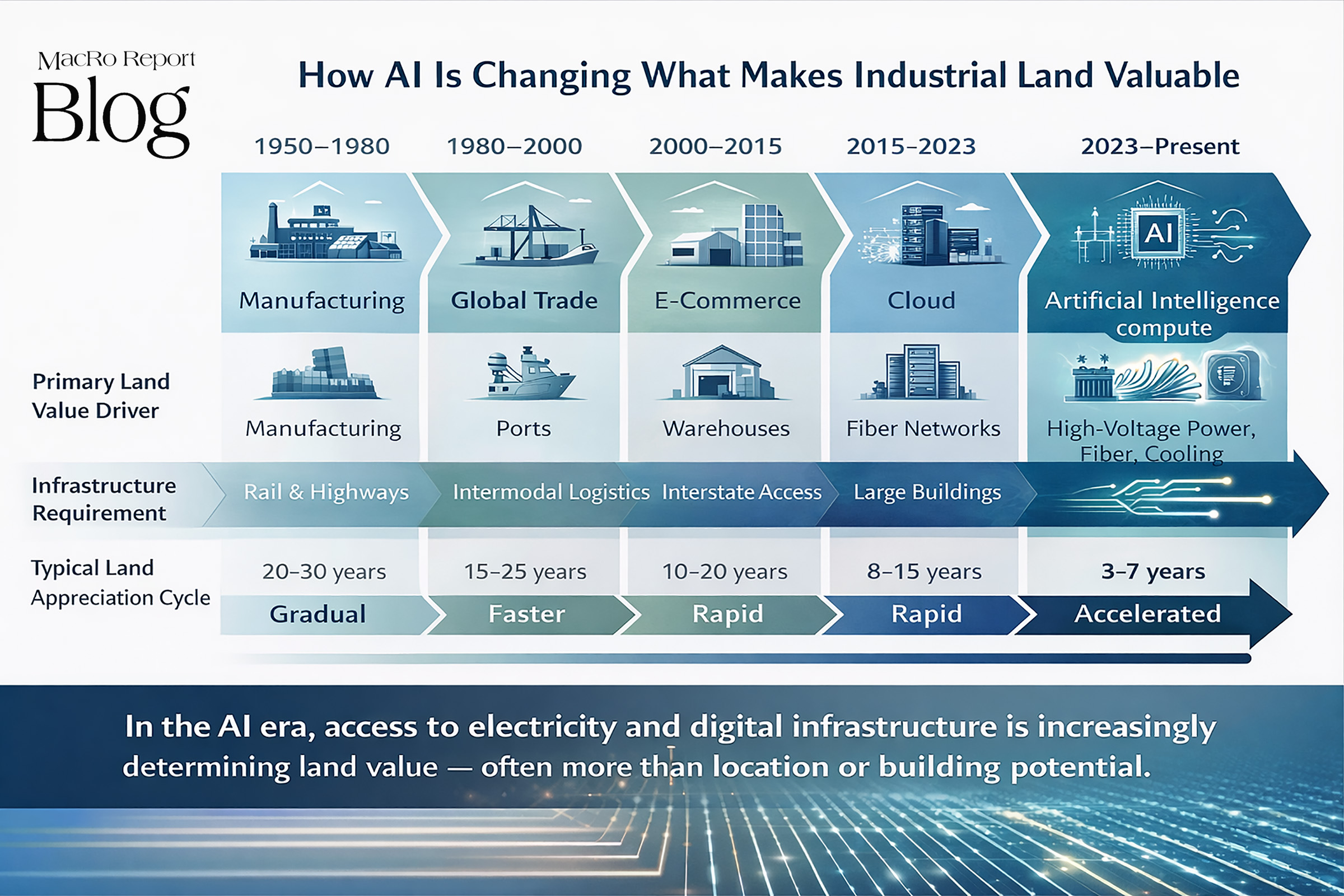
In this the 13th MacRo AI Series and follow-up to Part 1 on how AI is reshaping land values, we examine how power — not location — is becoming the primary driver of industrial land value, forcing a rethink of traditional real estate valuation models in the AI era.
In Part 1, we explored how artificial intelligence is driving a new kind of demand for industrial land — one centered not on transportation, but on computing power. That shift is now beginning to reshape how land itself is valued.
For most of the past century, industrial real estate followed familiar valuation methods:
- Comparable sales
- Income potential
- Replacement cost
These models worked because industrial demand was relatively stable and predictable.
AI changes that.
Today, the value of certain industrial sites is increasingly tied to a factor that traditional real estate models were never designed to fully capture: energy infrastructure.
In many cases, the most valuable aspect of a property is no longer the building it can support, but the amount of electricity that can be delivered to it.
That creates a new dynamic.
Two properties with similar size and zoning can have dramatically different values depending on:
- Transmission access
- Substation capacity
- Ability to scale power delivery
This helps explain why some industrial land values are rising so quickly. Developers are not just purchasing land—they are effectively securing access to limited electrical capacity.
And that capacity is becoming scarce.
Across the country, utilities and grid operators are reporting growing backlogs of interconnection requests. New transmission lines can take years to permit and build. Power generation—whether natural gas, renewable, or nuclear—faces regulatory, environmental, and financing hurdles.
At the same time, AI-driven demand continues to grow.
This creates a structural imbalance:
- Compute demand is scaling rapidly
- Energy infrastructure is scaling slowly
That imbalance is compressing what used to be long-term appreciation cycles into much shorter timeframes.
Places that have existing infrastructure — particularly former industrial sites — are seeing the effects first.
Frederick County is one example. The former Eastalco site, with its existing transmission infrastructure and industrial history, illustrates how a property can transition from underutilized land to a key node in the digital economy.
Importantly, this is not just a real estate story. It is an infrastructure story.
As AI continues to expand, the limiting factor may not be land, buildings, or even technology—but the ability to generate and deliver electricity at scale.
That reality is already shaping policy discussions around zoning, energy planning, and economic development.
And it raises a broader question:
If power becomes the defining constraint on growth, how should communities plan for the future?
Become a MacRo InsiderWith more than 50 years advising regional landowners, investors, and institutions, Rocky Mackintosh, Broker of MacRo, LTD has firsthand experience supporting nationally recognized hyperscalers with site search and selection services throughout the Mid-Atlantic. Our team has worked at the interface of land planning, infrastructure analysis, and high-value redevelopment—experience that uniquely informs our understanding of projects like Quantum Frederick.