
County Executive Jessica Fitzwater has heard the voters. She has taken steps to address their data center concerns; so, what should come next?
With the 2026 Frederick County Primary Election now behind us, one thing has become abundantly clear: regardless of where one stands on data centers, many Frederick County voters wanted their concerns to be heard.
The election did not determine whether data centers will become part of Frederick County’s future. In many respects, that question has already been answered. Fifteen data center buildings are now in various stages of construction at the Quantum Frederick campus, representing one of the largest private investments ever made in our county.
What the election did tell us is something equally important: many residents want greater transparency, stronger communication, and a larger voice in how this transformation unfolds.
That is why I was encouraged to see County Executive Jessica Fitzwater announce a temporary pause on new data center approvals while also restarting negotiations toward a Community Benefits Agreement. Just as importantly, she acknowledged that many residents feel they have not been heard. Recognizing that reality is an important first step toward rebuilding confidence.
A well-crafted Community Benefits Agreement has the potential to become much more than another government document. It can establish a framework for transparency, accountability, and long-term cooperation between county government, developers, data center operators, and the surrounding community.
But rebuilding trust cannot be the responsibility of government alone.
To be fair, several companies involved in Quantum Frederick have already taken meaningful steps. Rowan Digital Infrastructure, for example, has made a visible effort to engage nearby residents through community meetings, project updates, and ongoing outreach as construction has progressed on its three campuses. Catellus Development has also increased its community engagement since assuming leadership of the project following the departure of Quantum Loophole. These efforts deserve recognition because they demonstrate an understanding that successful development requires more than engineering and construction—it requires communication.
The opportunity now is to build upon those efforts.
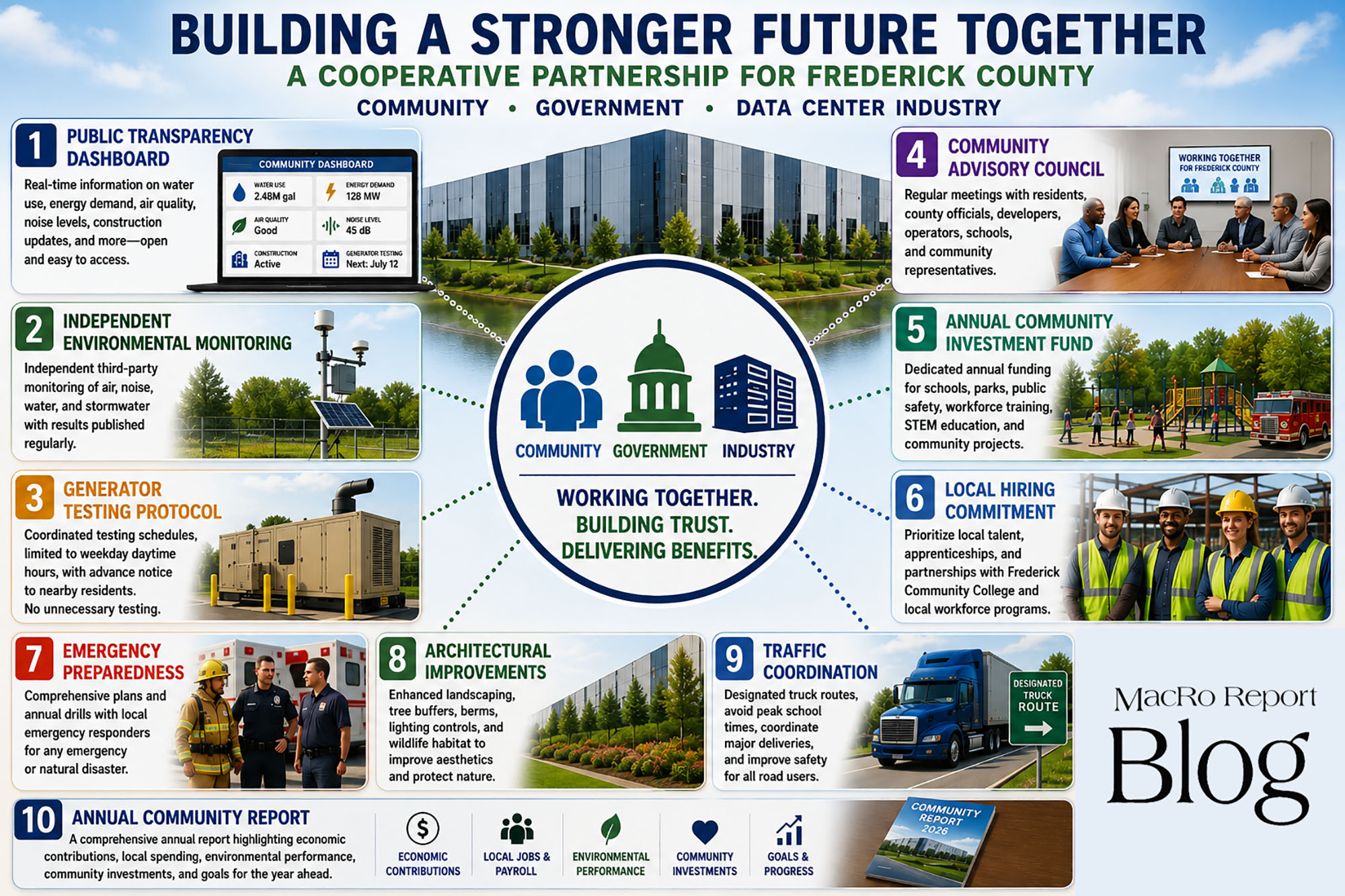
Rather than viewing community outreach as something that occurs only during the approval process, the developers and operators could work together to create a long-term partnership with the surrounding community. Imagine a coordinated initiative that includes regularly scheduled public meetings, an online dashboard reporting water use, environmental monitoring, generator testing schedules, noise monitoring, construction updates, and annual reports highlighting local hiring, charitable investments, and economic contributions.
A community advisory council representing residents, county officials, developers, operators, schools, environmental organizations, and the business community could meet regularly to discuss issues before they become controversies rather than afterward.
Many of these ideas would not require changes to existing approvals or lengthy legal proceedings. They are voluntary commitments that demonstrate respect for the community and a willingness to become long-term corporate citizens rather than simply project developers.
Throughout the past several months, the MacRo Report has attempted to present factual information about Quantum Frederick—from power, water, and taxes to land values and artificial intelligence. My goal has never been to minimize legitimate concerns or to dismiss the many economic opportunities these projects can bring. It has been to encourage informed discussion based on facts rather than assumptions.
The primary election reminds us that facts, while important, are only part of the equation.
Communities also need trust.
Developers need public confidence.
Local government needs credibility.
None of those goals are mutually exclusive.
The approvals have largely been granted. The cranes are already in the air. The question is no longer whether Quantum Frederick will be built. The question is whether it will become a project that Frederick County simply accepts—or one that the community ultimately comes to embrace. That outcome depends less on permits and regulations than on the relationships that are built from this point forward.
The election is now behind us, the court proceedings have concluded, and construction continues. So, rather than allowing the community to remain divided, this is an opportunity for county government, developers, operators, and residents to begin writing a different chapter—one built not on litigation or political campaigns, but on communication, accountability, and mutual respect.
Ultimately, the future success of Quantum Frederick will be measured not only by the buildings that are completed, but by the relationships that are built alongside them.
Become a MacRo Insider
Rocky Mackintosh, Broker of MacRo, LTD has been advising regional landowners, investors, and institutions for over 50 years. He has been an active member of the Frederick community for over five decades and has served on a number of community organization boards, including as a member of the Frederick County Charter Board from 2010 to 2012. He has firsthand experience supporting nationally recognized hyperscalers with site search and selection services throughout the Mid-Atlantic.