
This is Part 4 of what has now evolved into a five-part series where Rocky Mackintosh has been researching recent real estate acquisitions and construction projects undertaken by Frederick County Government. Its workforce housing plans at Bank Court raise new questions about communication, due diligence, and good governance.
It often happens that when a new family moves into the community, the next-door neighbors or the new arrival will reach out to introduce themselves. Heck, it’s the neighborly thing to do!
That will even happen in a decades old and very established business park like Westview. So, it is not necessarily unusual to receive a friendly email from your new neighbor announcing that they’ve just purchased the property next door.
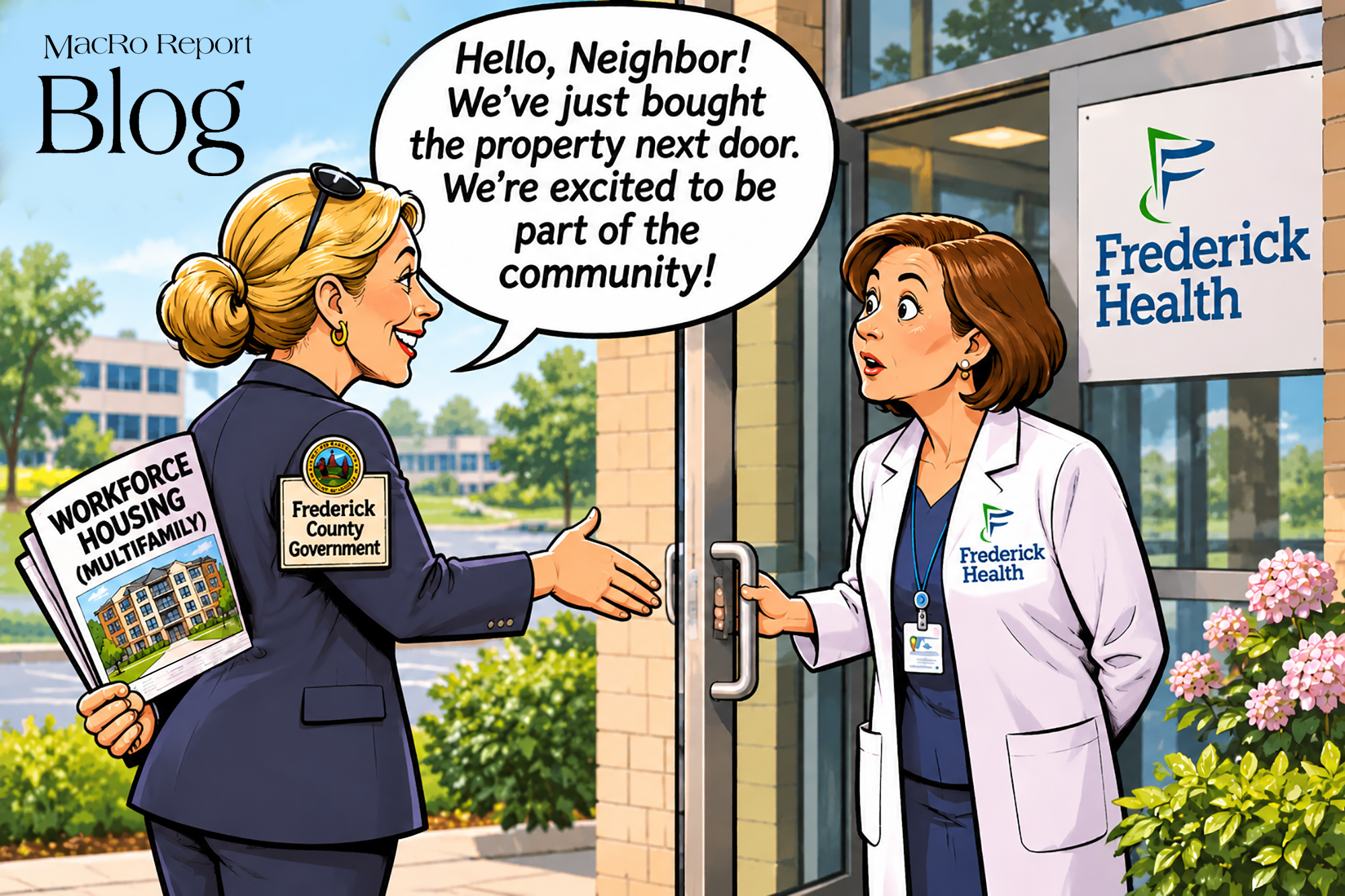
Sounds pleasant enough. Until you discover that your new neighbor is Frederick County Government, and instead of another office building, they’re planning a multifamily workforce/affordable housing project on the property you believed would remain part of the office park.
That, apparently, is how representatives of Frederick Health learned about the county’s acquisition of the 4.82-acre property at 7221 Bank Court.
And from what I’ve learned, the news was not particularly well received.
An Unexpected Announcement
In recent conversations with several individuals close to the situation, it seems that the county notified the healthcare organization by email that it had purchased the adjoining property with the intent to pursue a workforce/affordable housing project there.
Based upon what I have learned, Frederick Health representatives were unpleasantly surprised by the announcement. Their well-established understanding was that with the majority of the park being zoned ORI, that lot would be restricted to office or industrial research use.
Frederick Health occupies its nearby medical facility under a long-term lease. The facility provides outpatient medical services, including diagnostic imaging, women’s health, rehabilitation, and related healthcare services.
Frederick Health is not a minor player in our local economy. According to the Frederick County Office of Economic Development, it is the county’s largest nongovernmental employer and third-largest employer overall, with approximately 3,500 employees.
Wouldn’t it have made sense for the county to have discussed its intentions with such an important neighboring institution before purchasing the property?
More Than Just a Vacant Lot
The Bank Court property is not simply 4.82 acres of vacant land awaiting development.
It is already improved with parking areas, utilities, stormwater infrastructure, and a prepared building pad intended for another office building.
Based upon my research, the property is also subject to several easements, including rights allowing Frederick Health to use parking on that site.
Those rights could have significant implications for any proposed redevelopment.
There is also the matter of underground conditions.
Anyone familiar with commercial development in the Westview area knows that rock excavation can be an expensive proposition. It’s a well-known fact that nearby developments have encountered substantial rock-related site improvement costs.
More than likely, similar conditions exist beneath the Bank Court parcel, constructing multifamily housing could prove considerably more expensive than anticipated.
These are not necessarily insurmountable obstacles. But they are precisely the kinds of issues that should be thoroughly investigated before committing public funds to a particular development strategy.
But What Does the Existing Zoning Allow?
There is another important consideration. The 7221 Bank Court property is zoned ORI (Office/Research Industrial), a classification specifically intended for office buildings, research facilities, limited manufacturing, and compatible commercial activities.
Under Frederick County’s zoning ordinance, conventional residential development, including multifamily apartment buildings, is not a permitted use in the ORI district.
That helps explain why Frederick Health understood the surrounding property to be part of an office park rather than a future residential development.
While the county has certain special authorities concerning the development of publicly owned property, those provisions do not automatically establish that conventional multifamily housing can be constructed under existing ORI zoning.
So, if the county purchased Bank Court with the intention of developing workforce housing, why was the property not included in the October 6 rezoning actions along with 7185 Crestwood Boulevard? And what approval process does the county now intend to follow?
Those are questions that deserve answers before additional taxpayer funds are committed to development.
What Happened to the Rezoning?
In Part 3 of this series, I discussed the County Council’s October 6, 2026, adoption of the Investing in Workers and Workplaces (IW2) Plan through Resolution 26-27.
The county’s nearby 7185 Crestwood Boulevard property was part of a joint purchase with the 7221 Bank Court site from the same property owner on August 18, 2026. As noted in last week’s post, both parcels were acquired using American Rescue Plan Act (ARPA) and Housing Initiative Fund resources combined with a tax-deductible charitable donation of land from the seller. However, of the two, only the Crestwood site was included in the associated rezoning actions, receiving a multifamily residential zoning designation.
Interestingly, however, the Bank Court property was not included in that package.
Could the concerns expressed by Frederick Health have influenced the county’s decision not to pursue a similar zoning change at Bank Court?
Perhaps. But I have found no documentation establishing that connection.
It is a question worth asking, particularly because according to the real estate broker who represented the county, both properties were acquired for its housing initiatives.
Could This Lead to a Legal Dispute?
Given the reported easements, shared parking rights, and longstanding expectations concerning the property’s use, I wouldn’t be surprised that if the county were to pursue its multifamily development plans on that site, it may result in an eventual legal challenge.
That is my own observation, not a prediction that litigation will occur.
The enforceability and extent of those property rights will depend on the actual recorded agreements, which deserve careful examination.
But why risk a potential dispute when an early conversation with the adjoining property occupant might have identified these concerns before the acquisition?
Did the county fully investigate the recorded easements, shared parking arrangements, and other development restrictions before purchasing the property?
And if it did, how were those issues evaluated in determining the property’s suitability for workforce housing?
The Bigger Issue: Good Governance
I have no objection to Frederick County pursuing affordable and workforce housing. The need is real, and identifying appropriate development sites is an important public responsibility.
But acquiring property for a worthwhile purpose does not automatically make every acquisition a sound investment.
Good governance requires more than good intentions.
It requires thorough due diligence, realistic development cost estimates, meaningful communication with affected property owners, and transparency with both the County Council and the taxpayers who ultimately bear the financial responsibility.
In this case, according to the accounts shared with me, the county informed Frederick Health of its plans only after purchasing the adjoining property.
Wouldn’t a conversation before the purchase have been a more sensible starting point?
We still don’t know whether the Bank Court property will ultimately be developed for workforce housing, whether existing easements will complicate those plans, or whether the county intends to pursue a future zoning change.
What we do know, based on my conversations, is that representatives of a major Frederick County employer were surprised by what their new neighbor intended to do.
And that brings us back to the question running throughout this series:
Are Frederick County’s real estate acquisitions being guided by a comprehensive, publicly understood strategy—or are taxpayers learning about the plans only after the deals are done?
Become a MacRo InsiderRocky Mackintosh, Broker of MacRo, LTD and Associate Broker/Senior Advisor with Mackintosh Commercial Brokerage has been advising regional landowners, investors, and institutions for over 50 years. He has been an active member of the Frederick community for over five decades and has served on a number of community organization boards, including as a member of the Frederick County Charter Board from 2010 to 2012. Learn about his recent affiliation with Mackintosh, Inc., Commercial Real Estate.