
In this Part 1 of a three-part series, Rocky Mackintosh takes an in-depth examination of Frederick County Government’s real estate planning, acquisition, and construction decisions.
An existing office building can look like an attractive opportunity for local government. Purchase it below replacement cost, adapt it to public needs, consolidate services, and save taxpayers money.
But that calculation depends on knowing what the adaptation will cost—and controlling what the project becomes.
Frederick County’s Prospect Center raises questions on both counts.
The county purchased the former State Farm office property on Himes Avenue in October 2021 during County Executive Jan Gardner’s administration. State assessment records show a $20.4 million transaction for approximately 209,000 square feet on nearly 26 acres.
There is a useful local comparison. Frederick Health acquired the property now known as Frederick Health Village on Monocacy Boulevard in late 2019. State assessment records list a $17 million transfer for approximately 383,000 square feet on nearly 84 acres. The building dates to 1995, compared with 1965 for Prospect. Using the assessment records, the acquisition prices work out to be approximately $44.34 per square foot for the hospital property and $97.52 for Prospect. That is less than half the price per square foot, with more than three times the acreage.
One comparable sale does not establish market value, but the differences between these transactions deserve examination.
My larger concern, however, is what happened after the county decided to buy.
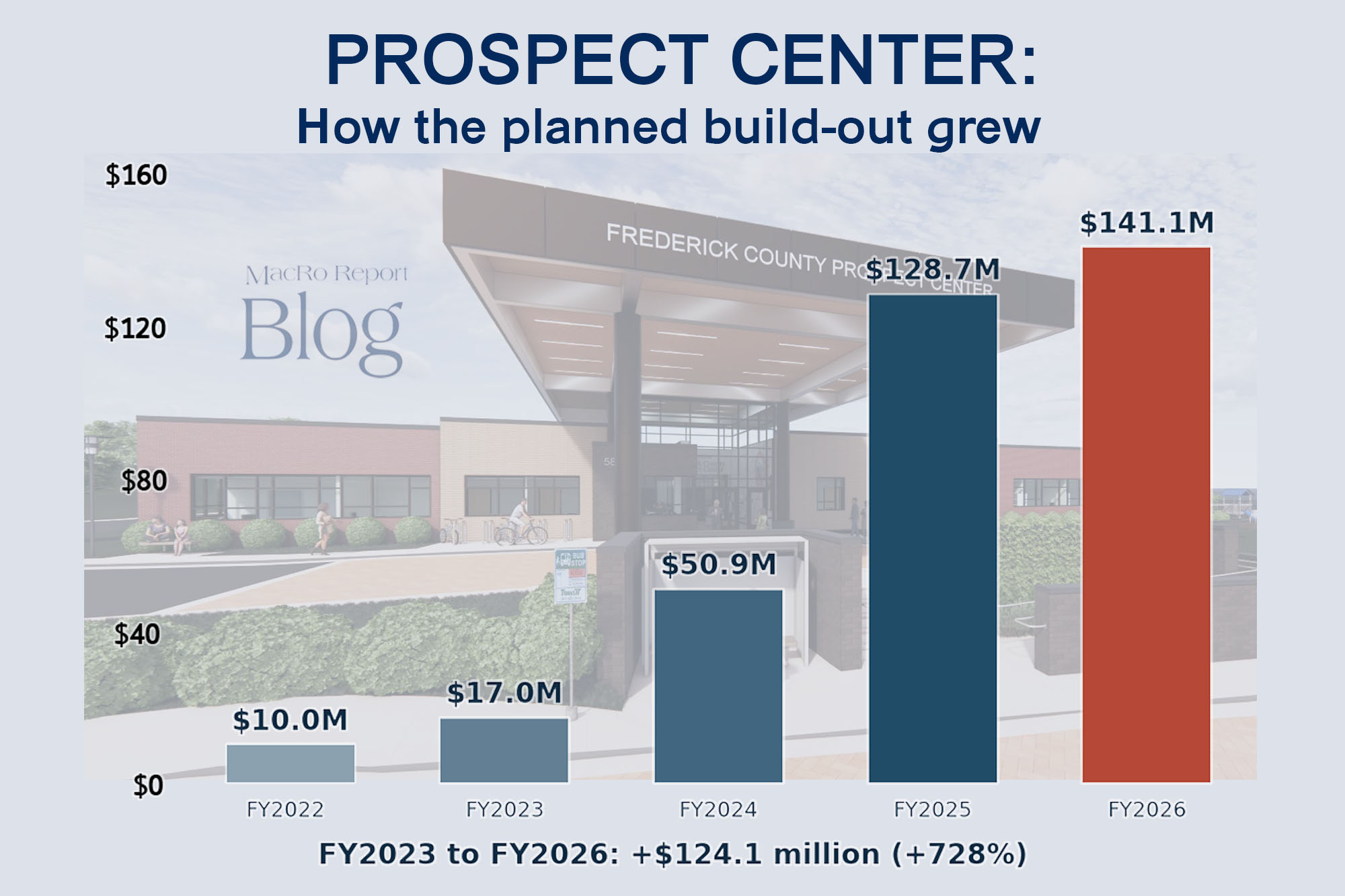
On May 17, 2022, in the final year of County Executive Gardner’s term, the County Council adopted the FY2023 capital budget. It identified a prior construction allocation of $10 million for Prospect Center—then called “Oak Street Building Acq & Build Out”—and added approximately $7 million for construction. That brought acquisition and construction together to roughly $37.5 million, or $179.25 per square foot of the existing building. The description contemplated multiple county departments and a possible 911 center. The construction allocation amounted to approximately $81.48 per square foot—a much more modest starting point, although the adequacy of that estimate depends on the work it actually covered.
Three years later, the County Council adopted the FY2026 capital plan with a total Prospect Center project budget of approximately $161.5 million. Excluding acquisition, the plan contains roughly $141.1 million for construction, design, equipment, technology, and other project costs. The main construction line increased from approximately $17 million in the FY2023 plan to $123.2 million—more than sevenfold. The scope also expanded, so this is not a comparison of prices for identical work. These are planned costs, not a claim that the county has already spent or appropriated the entire amount.
The cost deserves more than a passing explanation.
The main construction line alone is approximately $123.2 million. Using an illustrative 220,000-square-foot assumption, that amounts to approximately $560 per square foot, before separately budgeted design, equipment, and other expenses. Include all project costs apart from acquiring the property, and the figure reaches approximately $641 per square foot. These ratios include site and supporting infrastructure costs; they are not simply prices for interior office renovations. County staff should confirm the final building area and publish a breakdown that allows a fair comparison.
In my judgment, that is a high figure for adapting an existing office property, and it demands an independent comparison with market costs.
For perspective, Gordian’s RSMeans conceptual model, published in July 2026, places construction of a two-to-four-story office building in Washington, D.C., at approximately $249 per square foot. That model is not a complete development budget or a direct estimate for Prospect, and differences in scope prevent treating the gap as proof of overpricing. Nevertheless, the difference is substantial enough to require the county to explain exactly what accounts for it.
An emergency/911 center understandably costs more than ordinary office space. Redundant power, secure communications, specialized equipment, and structural protection are legitimate requirements. The county describes extensive building-system replacement, structural upgrades, and a solar-and-battery microgrid at Prospect.
But acknowledging those requirements is only the beginning of a financial explanation.
How much space requires that premium, what is the premium, and what does the remaining government space cost?
According to a “Frederick County Prospect Center” staff presentation to the County Council in September 2024, the following divisions will have offices and/or offer services there with 587 county employees reporting out of the property:
- Family Services (DFS)
- Aging & Independence
- Housing
- Health Services (DHS)
- Human Resources (HR)
- Interagency Information Technologies (IIT)
- Emergency Management (DEM)
- Public Works (DPW)
- Parks & Recreation (DPR)
While the uses are well identified, I was unable to find a detailed breakdown of why the estimated costs increased so dramatically. In speaking with one of the current County Council members, I was informed that the members were told that it is very expensive to build out a 911 center. Not much more of a breakdown was given.
If that is the case, taxpayers should not have to accept “it includes a 911 center” as a sufficient explanation for the higher cost estimates of the entire project (see Frederick County FY 2026 Third Quarter Financial Analysis Page 31). County staff should publish separate estimates for emergency operations, ordinary offices and public-service areas, and shared infrastructure.
Nor would it be fair to label the entire increase a construction overrun. The scope has changed, and the early and later budgets do not cover identical work.
That is precisely why what appears to be mission creep deserves scrutiny.
Did the county’s initial plan adequately anticipate the departments, specialized facilities, and infrastructure now included? If not, when did the scope change—and who approved those changes?
Over my five decades in commercial real estate, I have worked with private developers, local governments, and nonprofit organizations to analyze new projects and expansions. Government facilities can have distinctive requirements. Even so, when a project’s scope and costs expand this dramatically, a private developer will stop and reassess whether the investment still makes economic sense. Taxpayers deserve the same discipline.
Local government is accountable to taxpayers, who expect their dollars to be spent wisely—even frugally.
For Prospect Center, several questions need answers:
- At what point was the expanded project compared with leasing, other properties, or new construction?
- Was an independent financial analysis prepared to test the economics of the expanded project?
- Who has been monitoring the cumulative cost?
- What limits or reporting requirements did the County Council impose as costs increased?
- Which programs and additions were essential, and which could have been deferred or housed elsewhere?
- In exchange for the new facilities at the Prospect Center, what other county owned properties can be decommissioned and returned to the county tax rolls?
- Did the County Council receive timely, detailed information explaining the increases in the project’s cost?
- Are there more economical locations for these county services?
If converting this property requires such extensive reconstruction that its original economic advantage has disappeared, the county needs to acknowledge that and reconsider its approach.
The original acquisition and roughly $17 million construction allocation appeared to offer a more economical path, but that premise needed testing as the scope changed. Responsibility spans the administrations and councils that proposed and approved the project’s successive budgets. As she will likely enter her second term, my advice to County Executive Fitzwater is to have her staff better explain the decisions reflected in the expanded plan. Approving funding establishes authorization; it does not establish that taxpayers received a convincing explanation of the project’s evolving economics.
The next question from an oversight perspective is to ask staff: What checks and balances govern changes in scope?
Taxpayers should be able to see a clear history showing each major addition, its cost, who authorized it, and its effect on the completion schedule. They should also see an independent assessment of whether the expanded project remains the most economical way to meet documented needs.
Each proposed improvement may have a worthy purpose. Responsible stewardship requires evaluating their combined cost—and deciding when to say no or find a more economical route.
Become a MacRo InsiderRocky Mackintosh, Broker of MacRo, LTD and Associate Broker/Senior Advisor with Mackintosh Commercial Brokerage has been advising regional landowners, investors, and institutions for over 50 years. He has been an active member of the Frederick community for over five decades and has served on a number of community organization boards, including as a member of the Frederick County Charter Board from 2010 to 2012. Learn about his recent affiliation with Mackintosh, Inc., Commercial Real Estate.
A few things that I note: The original development of both properties was State Farm Insurance. The Oak Street property was well utilized by State Farm and the Monocacy Blvd campus was open farmland which State Farm lightly utilized before selling a well strategized raw to future use real estate investment. The Oak Street location overlooks and is in close proximity to downtown. It also sits between an arguably poorly planned Golden Mile with high residential density and the downtown in fair proximity to Carroll Creek which has been developed as a city center. Due to timing of the Oak St development and the surrounding area it requires savvy, timely redevelopment with the high density, more modest population. It is unlikely that the larger, nicer Monocacy campus will truly compare even projected decades out.