
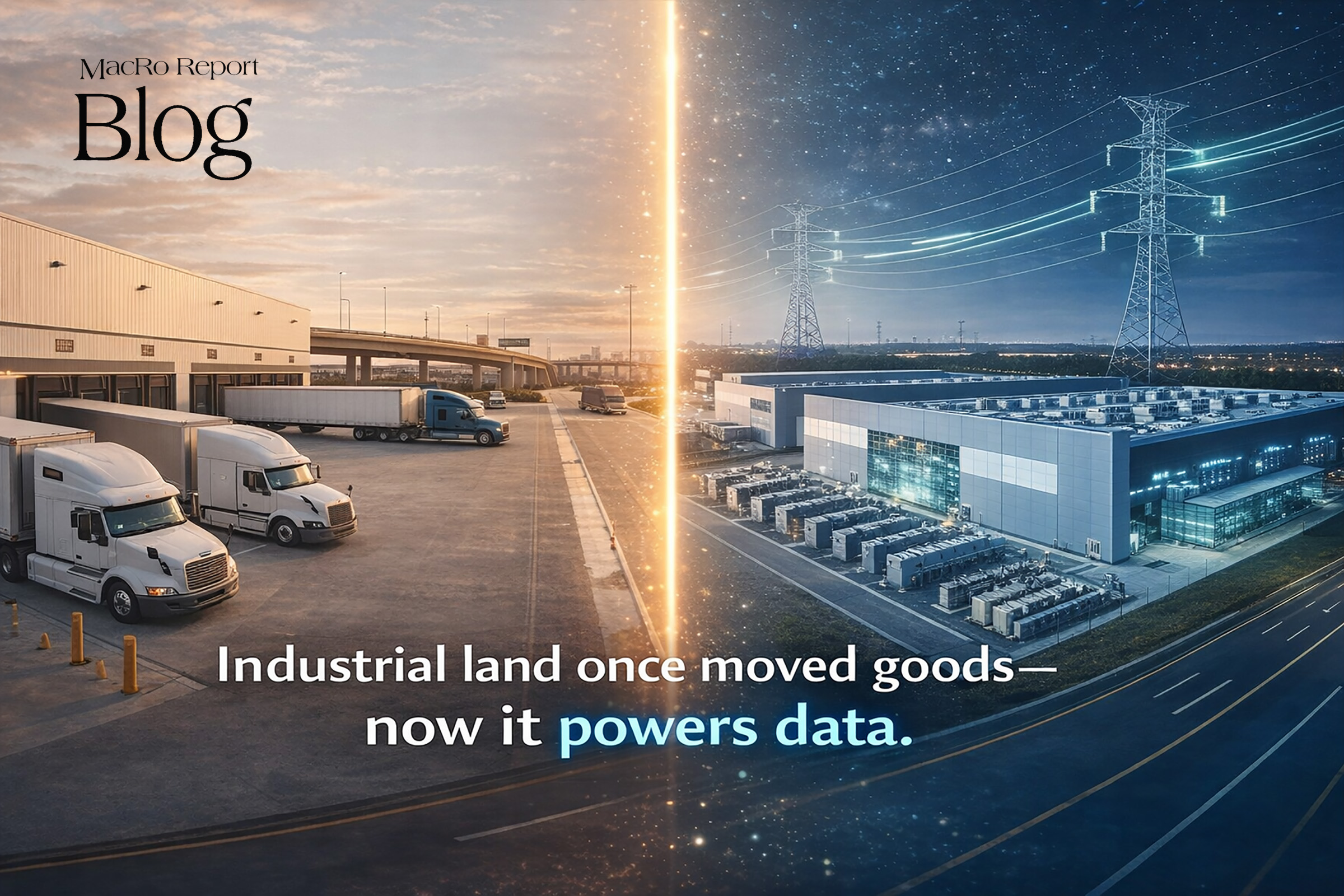
Today is the 12th post in the MacRo AI series. This is Part 1 of 2 which explores how artificial intelligence is creating a new kind of infrastructure demand—one driven by massive computing power and energy needs that is rapidly reshaping industrial land values.
For decades, industrial land values followed a predictable path. Growth was driven by manufacturing, logistics, and population expansion. Land near highways, rail lines, and ports gradually increased in value as infrastructure improved and demand expanded.
That model is now changing—and it’s happening faster than at any time in recent history.
Artificial intelligence is introducing a new type of infrastructure demand, one that is fundamentally different from anything that came before it. Unlike traditional industrial uses, AI doesn’t depend on moving goods. It depends on processing data at massive scale, and that requires enormous computing power.
Inside modern data centers, thousands of servers operate continuously, generating heat and consuming electricity at levels that would have been difficult to imagine just a few years ago. A single hyperscale data center building can require 30 to 60 megawatts of power, and multi-building campuses can reach hundreds of megawatts or more.
That level of demand is changing how developers think about land.
Historically, industrial sites were evaluated based on location—proximity to transportation networks, labor pools, and end markets. Today, the most critical factor is increasingly something else:
Access to power.
To support large-scale AI computing, sites must have:
- High-voltage transmission access
- Reliable and scalable electric capacity
- Fiber connectivity
- Large, contiguous land areas
Very few properties meet all of these requirements.
As a result, sites that do have this infrastructure are becoming highly sought after. What once might have been considered just another industrial parcel can quickly become a strategic asset if it has the ability to support large-scale energy loads.
This is one reason why former industrial sites—such as rail yards, power plants, and heavy manufacturing facilities—are being reexamined. Many of these locations already have the infrastructure needed to support high levels of power demand, making them ideal candidates for redevelopment.
What makes this shift unique is not just the scale of demand, but the speed at which it is occurring.
The rise of AI has accelerated infrastructure needs on a timeline measured in years, not decades. Technologies that barely existed a few years ago are now driving global investment in data centers and energy infrastructure.
Industrial land values are responding accordingly.
In the next post, we’ll explore how this shift is breaking traditional real estate valuation models—and what it means for places like Frederick County, where infrastructure-ready land is becoming increasingly valuable.
Become a MacRo InsiderWith more than 50 years advising regional landowners, investors, and institutions, Rocky Mackintosh, Broker of MacRo, LTD has firsthand experience supporting nationally recognized hyperscalers with site search and selection services throughout the Mid-Atlantic. Our team has worked at the interface of land planning, infrastructure analysis, and high-value redevelopment—experience that uniquely informs our understanding of projects like Quantum Frederick.