
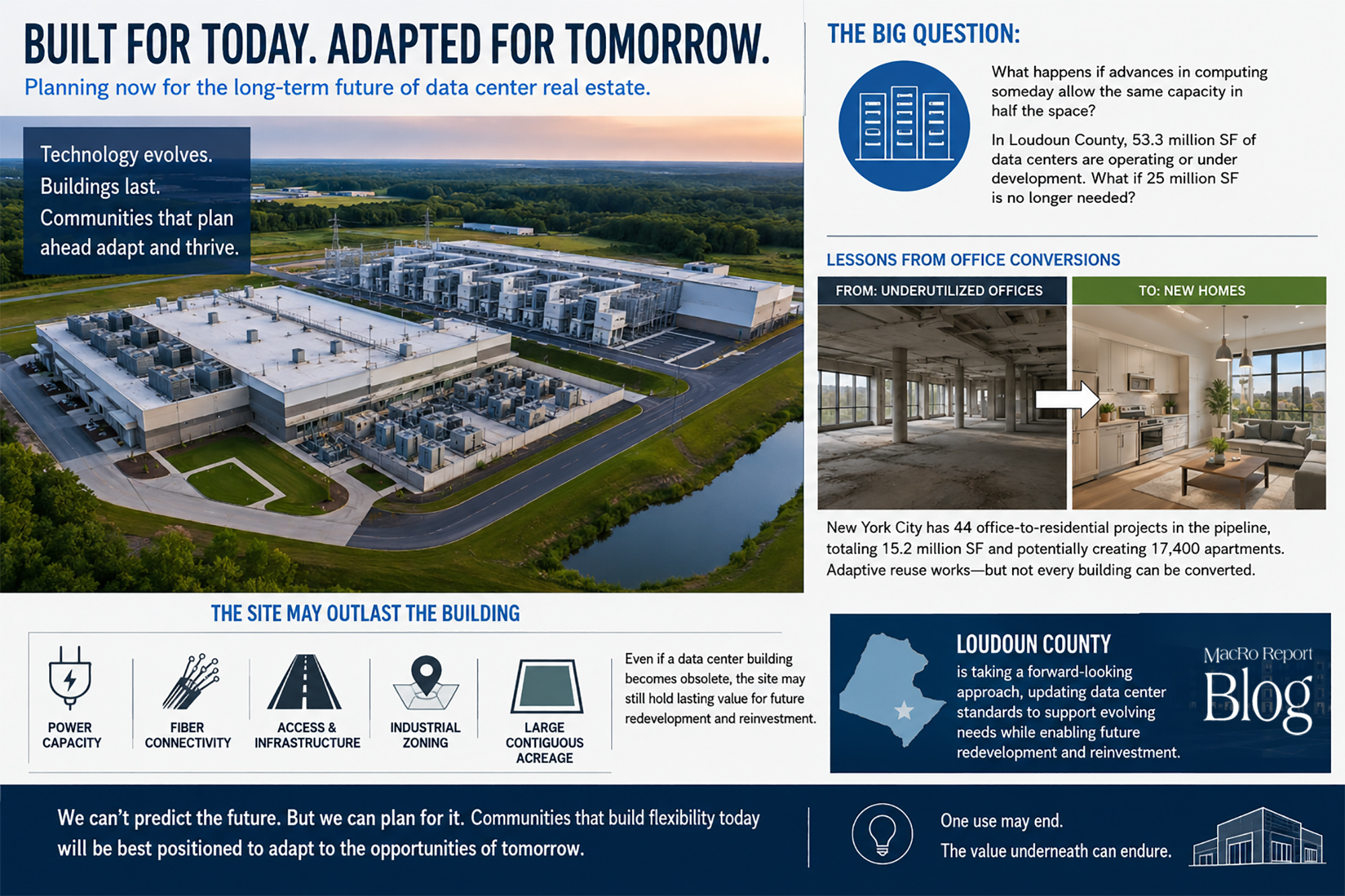
This is the 31st article of MacRo’s AI Corner, and Part 2 of a MacRo Report series examining technological change, functional obsolescence, and the long-term future of today’s massive data-center buildings.
In Part 1, I looked at Frederick County’s long history of adapting its real estate to economic and technological change.
The most obvious example is the former Eastalco aluminum smelting property, where much of Quantum Frederick is now being developed. Eastalco became obsolete for its original purpose, but the underlying real estate retained value.
But a reader raised an important objection to that comparison:
Scale.
Finding another purpose for an old knitting mill—or even redeveloping a former aluminum plant—is one thing. What happens if technological change someday leaves communities with tens of millions of square feet of highly specialized data-center buildings?
That’s a question worth examining.
Consider Loudoun County
Loudoun County, Virginia, roughly 30 to 40 miles south of Frederick County, offers some perspective.
The county reports approximately 53.3 million square feet of data-center space operating or under development—the equivalent of more than 100 buildings of 500,000 square feet each.
Now imagine advances in computing eventually allow the same processing capacity to occur in half the physical space.
What happens to the other 25 million square feet?
Nobody knows. But at that scale, functional obsolescence becomes a legitimate long-term real estate and planning question.
Interestingly, Loudoun is already looking ahead.
The county is reviewing its data-center policies and development standards to account for evolving industry requirements while seeking to avoid regulations that could unnecessarily hinder future redevelopment and reinvestment in existing data-center properties.
That doesn’t mean Loudoun expects its data centers to become obsolete. It means a community with more data-center experience than perhaps anywhere in America recognizes a basic principle of commercial real estate:
Buildings may last for generations. The businesses and technologies occupying them often don’t.
We’ve Just Watched This Happen to Offices
We don’t have to wait 30 years for an example.
COVID and the shift toward remote and hybrid work fundamentally changed office demand.
By the second quarter of 2025, suburban Maryland’s direct office vacancy rate had reached 17.1%, with total availability of 22.5%. Frederick County fared considerably better, with direct vacancy of 12.2%.
New York City illustrates what can happen next.
Faced with millions of square feet of underutilized offices, New York has encouraged office-to-residential conversions. By early 2025, the conversion pipeline included 44 buildings totaling more than 15 million square feet, potentially creating approximately 17,400 apartments.
But not every obsolete office building can become apartments.
Floorplates may be wrong. Windows, plumbing, and mechanical systems may be unsuitable. Sometimes conversion simply costs more than the finished property is worth.
Adaptive reuse isn’t magic.
The same would undoubtedly be true of obsolete data centers.
What Happens to a 500,000-Square-Foot Data Center?
Let’s assume the skeptic is right.
Suppose AI hardware becomes dramatically more efficient. Perhaps quantum computing assumes certain workloads now handled conventionally. Or perhaps something not yet invented changes computing altogether.
Imagine that 20 or 30 years from now the computing capacity requiring 500,000 square feet today requires only 250,000.
What happens to the rest?
The answer is: we don’t know.
The building might accommodate substantially more computing demand. It might be retrofitted for another generation of equipment. Portions could potentially accommodate advanced manufacturing, research, laboratories, or other industrial uses.
Or the building could eventually become functionally obsolete and be demolished.
And yes, some data centers could someday become stranded real-estate assets.
We shouldn’t pretend otherwise.
Greater Efficiency Doesn’t Always Mean Less Demand
There is another side to the equation.
Computers have become exponentially smaller, faster, and more efficient during my lifetime. Yet we aren’t using less computing capacity. We’re using vastly more.
But a recent discussion on the All-In Podcast raised the other possibility. Today’s extraordinary AI infrastructure buildout ultimately depends upon companies such as OpenAI, Anthropic and others continuing to purchase enormous amounts of computing capacity. If AI models become substantially more efficient—or projected demand fails to materialize—that spending could slow.
One participant described those major AI companies as a kind of “dead man switch” for the infrastructure boom: if they stop buying additional computing capacity, the effects could ripple backward through GPU manufacturers, data-center operators and ultimately infrastructure development.
On the other hand, greater efficiency could make AI cheaper and create entirely new applications, causing demand for computing power to grow even faster.
We simply don’t know which effect will dominate.
That uncertainty is precisely why the stranded-asset question is worth asking.
The Site May Matter More Than the Building
That brings us back to Eastalco.
When aluminum smelting ended, much of the specialized physical plant disappeared. But important characteristics of the property remained valuable.
The same could someday be true of data centers.
A major data-center site may have substantial electrical capacity, fiber connectivity, roads, utilities, industrial zoning, and large contiguous acreage.
Those assets don’t necessarily become obsolete because the computers inside the building change.
A future owner may ultimately value the property more for the infrastructure beneath and around the building than for the building itself.
Planning for What We Can’t Predict
This is where I think Loudoun’s approach offers a worthwhile lesson for Frederick.
We can’t predict what a 500,000-square-foot data center will be used for in 2055.
But we can ask whether our zoning allows future redevelopment, whether sites can accommodate reinvestment and whether today’s infrastructure retains value if the original use changes.
Those aren’t arguments against data centers.
They’re simply good long-range planning.
The economy that created Eastalco isn’t the economy creating Quantum Frederick. And the economy of 2055 almost certainly won’t look exactly like today’s.
Some buildings will adapt. Some will lose value. Some may disappear.
That’s commercial real estate.
Eastalco’s second life reminds us that the end of one use doesn’t necessarily mean the end of the value underneath it.
Become a MacRo InsiderRocky Mackintosh, Broker of MacRo, LTD has been advising regional landowners, investors, and institutions for over 50 years. He has been an active member of the Frederick community for over five decades and has served on a number of community organization boards, including as a member of the Frederick County Charter Board from 2010 to 2012. Learn about his recent affiliation with Mackintosh, Inc., Commercial Real Estate.